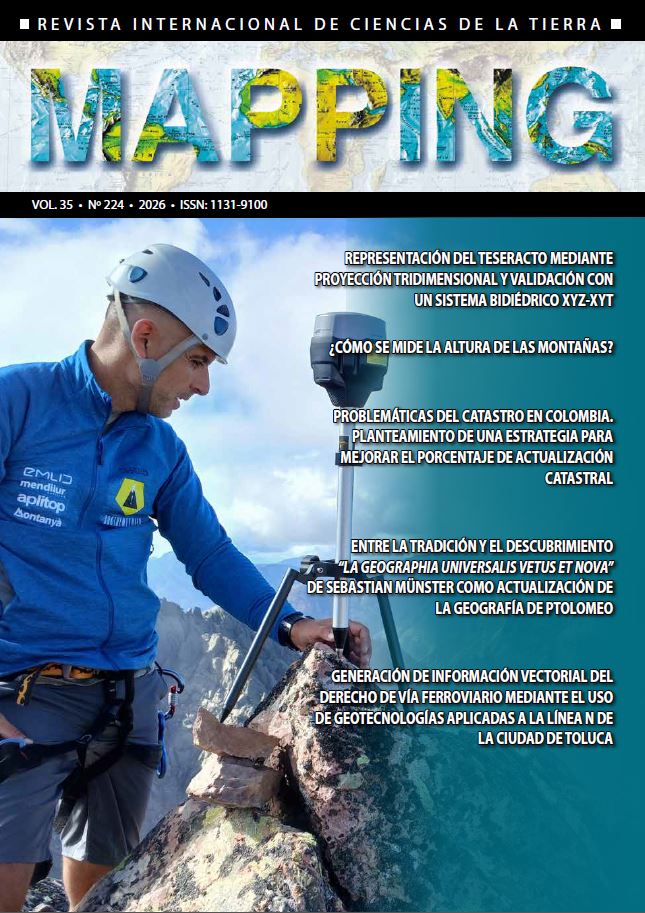
Representation of the tesseract through three-dimensional projection and validation using an XYZ–XYT bidihedral system
DOI:
https://doi.org/10.59192/mapping.506Keywords:
Tesseract, Fourth dimension, Projection, Descriptive geometry, Bidihedral system, Double dihedral systemAbstract
Four-dimensional geometry is rigorously defined from an analytical standpoint, yet a practical graphical tool equivalent to the dihedral system is still lacking: a system that allows operations on 4D objects to be carried out using rules, step by step, and with verifiable results, just as in 3D geometry. This paper proposes the bi-dihedral system, a direct extensión of classical dihedral projection. It consists of representing two three-dimensional spaces that share the X and Y axes: the physical space (X, Y, Z) and an auxiliary space (X, Y, T). Each space is represented by its own dihedral system (plan and elevation), and the two systems are arranged one above the other, using the same scale and sharing the same origin along the X-axis. Thus, a 4D point is defined by four linked projections connected by vertical reference lines, in the same way that the plan and elevation of a point are related in the classical dihedral system. On this basis, a central projection from 4D to 3D is defined using a projection centre, and it is demonstrated that, for the cells of a tesseract, this projection is equivalent to a homothety. As a validation, a complete example is solved both graphically and numerically: the familiar image of a tesseract—a cube within another cube—emerges as the result of a well-defined, verifiable construction rather than an interpretative drawing. The method opens the way to solving other four-dimensional geometric problems, including incidence, intersection, section, parallelism, and metric relationships, while preserving the operational approach of descriptive geometry.
Downloads
References
Izquierdo Asensi, F. (1980). Geometría descriptiva.
Downloads
Published
How to Cite
Issue
Section
License

This work is licensed under a Creative Commons Attribution-NonCommercial-NoDerivatives 4.0 International License.