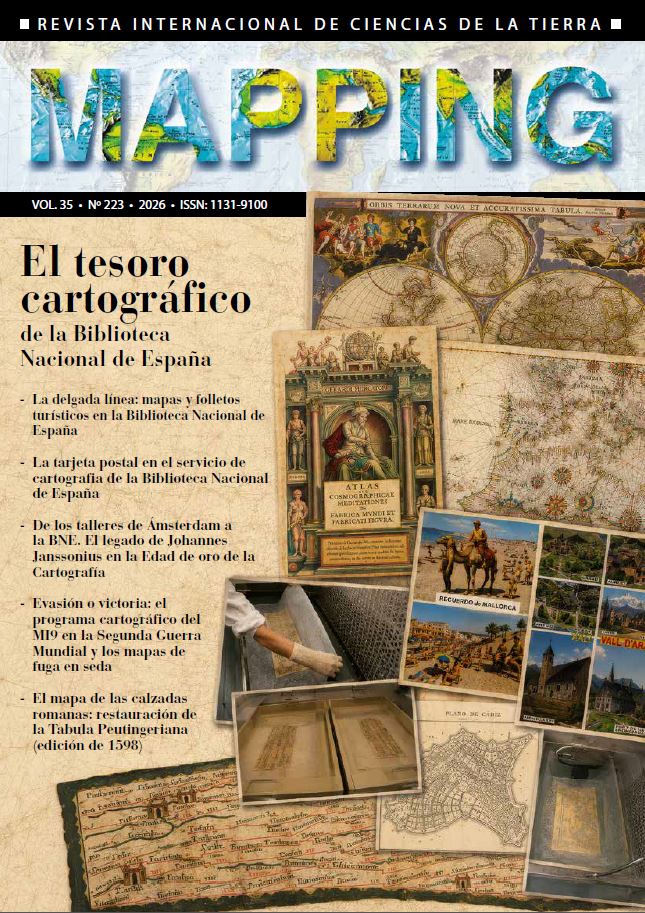
The thin line: maps and tourist brochures in the National Library of Spain
DOI:
https://doi.org/10.59192/mapping.499Keywords:
Travels, Tourism, Tourist brochures, Maps, National Library os SpainAbstract
The text analyzes the evolution of travel as a leisure activity, a relatively recent concept that was not previously associated with rest or pleasure. Thanks to the development of transportation, infrastructure, rising living standards, and the establishment of leisure time, travel came to be understood as a safe, desirable, and socially valued experience. To encourage this desire, advertising campaigns have played a fundamental role, with the tourist brochure standing out among their tools for its free availability, portability, and conciseness. Although these brochures often include attractive images, maps and plans fulfill a key function that goes beyond decoration. While some maps prioritize promotion over cartographic accuracy, many others are useful and combine different types of representation to guide travelers. Finally, the text highlights the impact of digitalization, while emphasizing the lasting value of the physical brochure as an accessible and appealing object for tourists.
Downloads
References
ESSSEX, Stephen (1992): «The use of maps in tourism marketing and management», en Society of Cartographers Bulletin, 26 (1), págs. 1-10.
RUBIO GIL, Catalina (2022): Análisis de los mapas turísticos promocionales (trabajo final de grado). Valencia, Universitat Politècnica de València.
SANCHO GASPAR, José Luis (1991): Cartografía histórica de Aranjuez: cinco siglos de ordenación del territorio, Aranjuez, Ediciones Doce calles. https://www.academia.edu/44024423/Cartograf%C3%ADa_hist%C3%B3rica_de_Aranjuez
Downloads
Published
How to Cite
Issue
Section
License
Copyright (c) 2026 Revista MAPPING

This work is licensed under a Creative Commons Attribution-NonCommercial-NoDerivatives 4.0 International License.